
Another Australasian Road Safety Conference done and dusted. This year we were in Sydney, with a packed program of research, technical presentations, interesting people and, as always, more good conversations than there were hours in the day.
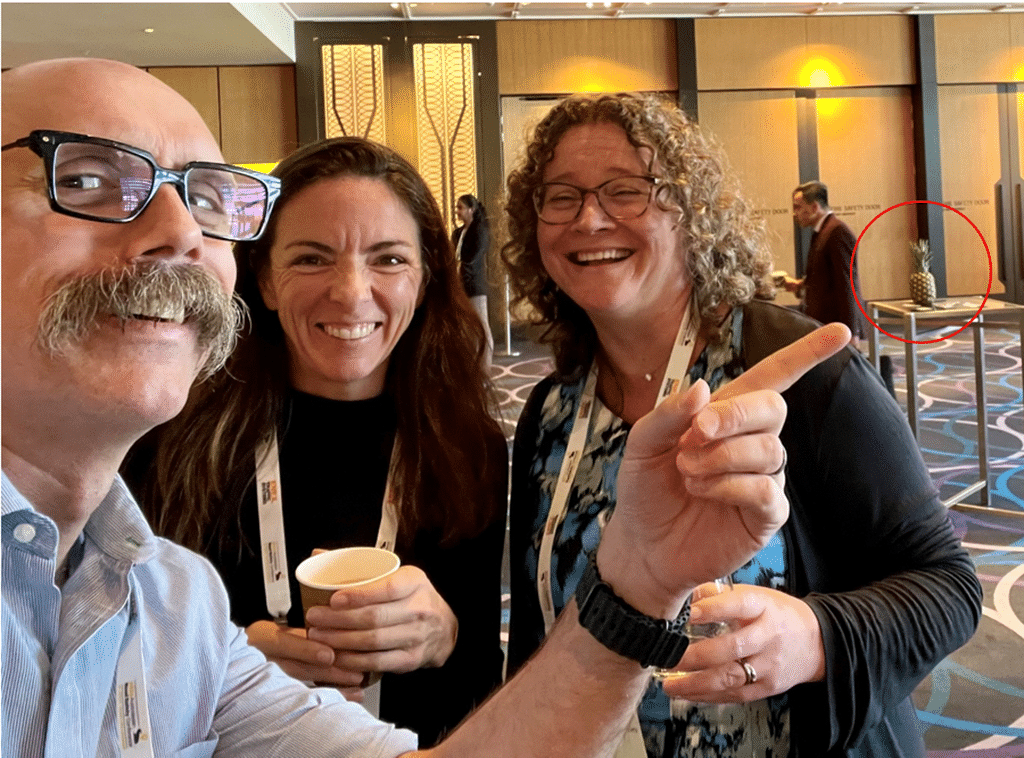
One of the things I enjoy most about these conferences is that some of the best discussions happen nowhere near a presentation screen. Over coffee, at dinner, between sessions, or while running along Sydney Harbour at an hour when most sensible people are still in bed.
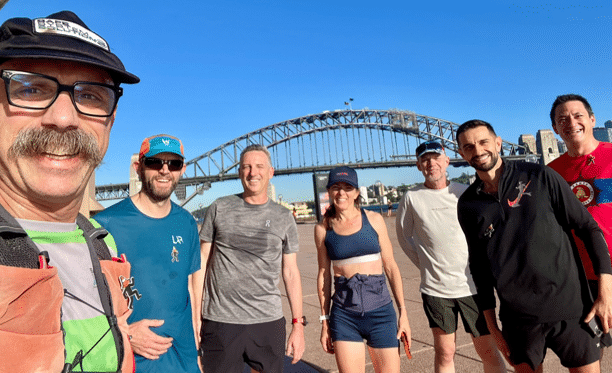
The morning Safety Strides runs (led by Jamie Mackenzie) have become a particularly good part of the conference experience. There’s something about running alongside people that makes for a different sort of conversation. You can cover a surprising amount of ground, both literally and intellectually, before breakfast.
As usual, I’ve jotted down ten themes from the presentations and conversations that caught my attention. These are particularly relevant to road and street designers, traffic engineers, road safety auditors and anyone trying to make our transport system a little less likely to kill or seriously injure people.
1. Are Our Own Rules Getting in the Way of Road Safety?
One of the most thought-provoking presentations came from Dr Andrew Burbridge, with the rather confronting title Legislated Danger: How Queensland’s Transport Legislation Precludes a Safe System.
Andrew argued that some of the legislation governing how we provide and operate road infrastructure actually embeds danger into the system. In other words, we are trying to create a Safe System while operating under rules that make that outcome difficult, or even impossible.
Andrew and I continued this discussion during one of the morning Safety Strides runs along Sydney Harbour. It certainly distracted me from the kilometres.
We spend enormous amounts of time discussing design standards, speed limits and treatments. But what if some of the fundamental rules governing the system are working against us?
It’s a discussion we need to have more often.
2. MOATS: Finding the Missing Links Before Someone Gets Hurt
One of my favourite developments was the progress being made with Maps of Active Transport Severance (MOATS).
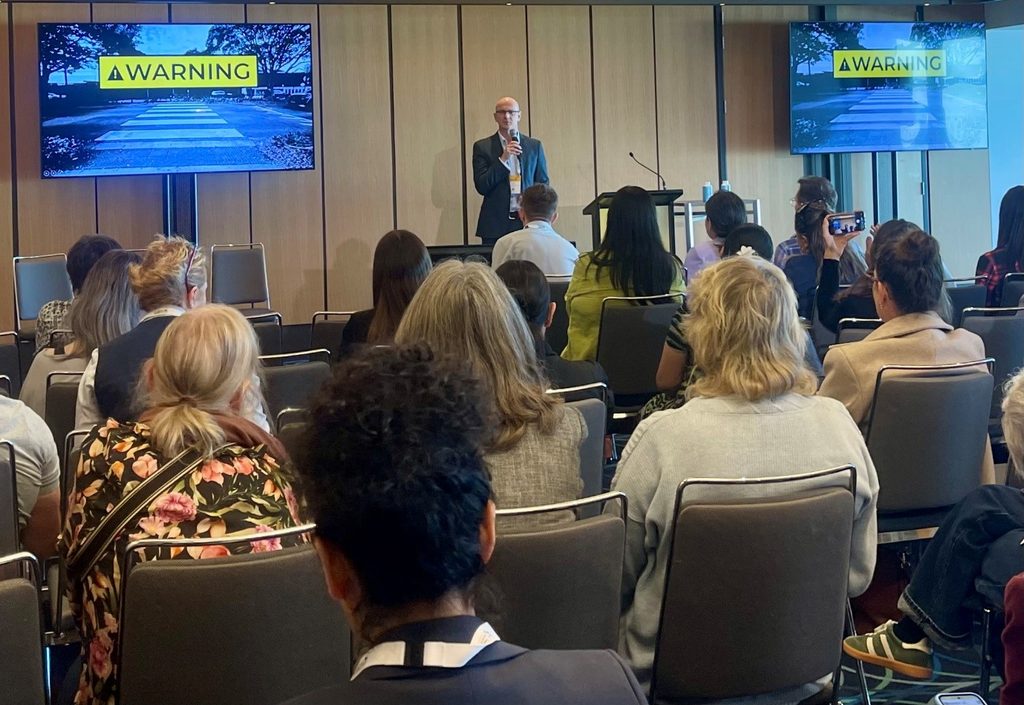
Two excellent presentations, from Prue Oswin and Professor Christian Jones, demonstrated how community knowledge can be turned into structured evidence to guide infrastructure investment.
Communities know where their walking and cycling networks don’t work. They know which roads are difficult to cross, where links are missing and where traffic speeds make people uncomfortable. But traditionally, we’ve been pretty poor at collecting that information systematically.
MOATS provides a standardised way to gather these experiences, map them and prioritise improvements. The new online version makes this even more accessible.
What I particularly like is that it shifts the focus from waiting for crashes to identifying where our transport network is already failing people.
For local governments, I think this is a must-watch development. It combines community engagement, road safety and active transport planning, with an evidence base to help decide where the money should go.
And importantly, it asks communities what they actually need rather than assuming we already know.
3. Speed Management: Better Evidence, Better Decisions
Speed management featured prominently again this year.
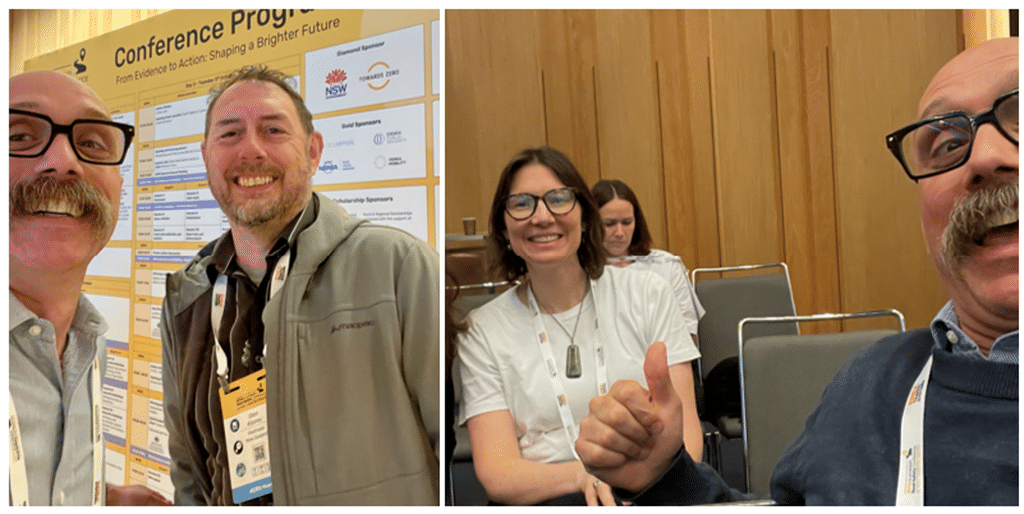
Anna Bray Sharpin presented on incorporating Movement and Place frameworks into speed management and Dr Glen Koorey presented modelling work examining how speed management affects both safety and mode shift. An important reminder that lower speeds can influence not just crash severity, but also people’s willingness to walk and cycle. Good to see the New Zealanders continuing to push for better speed management despite political challenges.
Closer to home, Dr Amir Sobhani presented excellent work using connected vehicle data to evaluate speed management outcomes.
There seems to be an almost endless supply of companies offering new traffic datasets, dashboards and analytics. Sorting out which data is genuinely useful, and which simply produces attractive graphics, is becoming a job in itself!
Amir’s evaluation of Mildura’s 40 to 30km/h trial found strong agreement between connected vehicle data and traditional tube counts, alongside reductions in speeds and estimated fatal or serious injury risk.
That’s the sort of work we need. Not just more data, but proper testing of whether we can trust it.
Daniel Mustata also presented research examining public support for lower speed limits in Melbourne. There were some interesting parallels with a poster I popped up about speed and risk perception, particularly around how people understand the risks associated with different speeds.
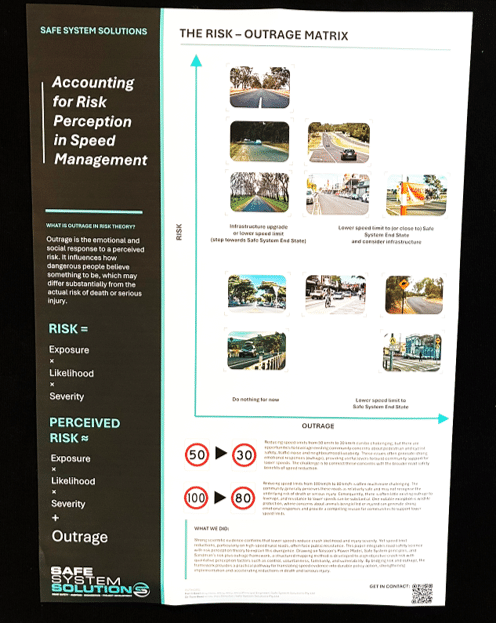
The challenge isn’t simply knowing what speeds are safer. It’s getting the community, decision-makers and practitioners to understand why.
4. Raised Crossings, Joey Crossings and Other Ways to Slow Vehicles At Conflict Points
It’s encouraging to see the conversation about pedestrian crossings moving away from simply telling drivers to give way and towards designing environments that encourage safe speeds.
Prue Oswin presented the new Austroads pedestrian crossing selection chart, which considers traffic speed and volume when identifying appropriate crossing treatments.
I’ll include a copy here because I think it’s something practitioners should have readily available.
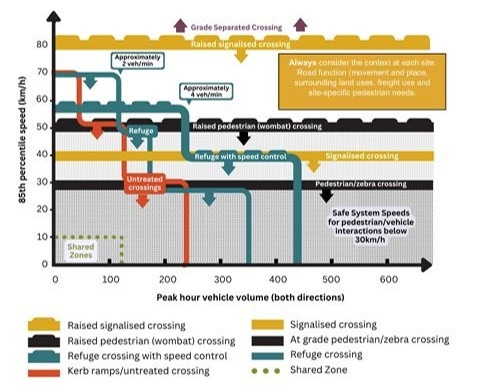
I also presented our work on Joey Crossings, a lower-cost approach using speed cushions on the approaches to zebra crossings.
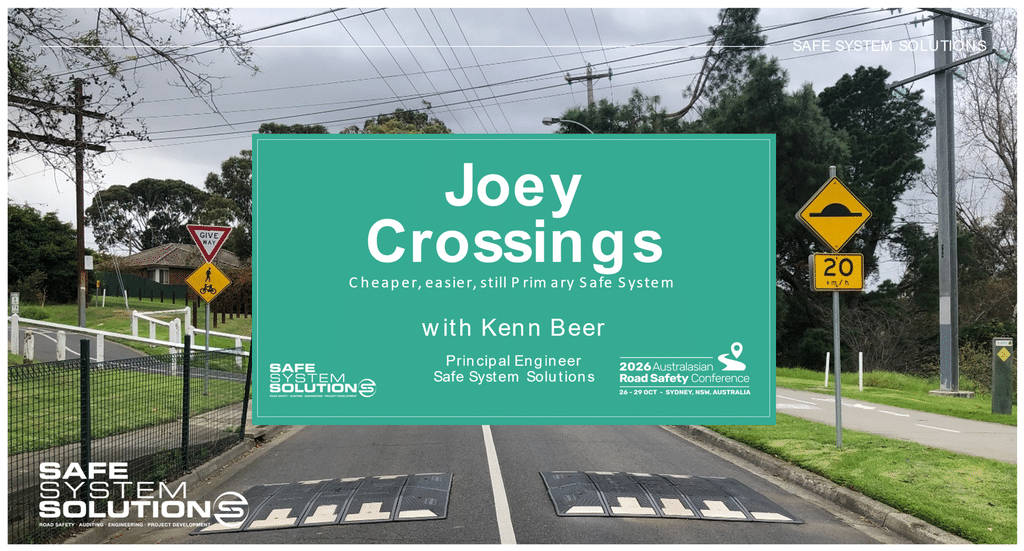
Conventional zebra crossings rely heavily on drivers seeing pedestrians and choosing to give way. They don’t physically control vehicle speeds. Fully raised crossings are a much stronger Safe System treatment, but cost and constructability can make them difficult to deliver.
Joey Crossings explore whether we can achieve meaningful speed management with a simpler and cheaper treatment.
They’re not intended to replace fully raised crossings everywhere. But if we can make treatments cheaper and easier to install while still achieving Safe System-aligned outcomes, we have the potential to treat many more locations with the same funding.
I’d rather see us spend less per treatment and save more lives across the network.
There was also an interesting presentation from Segundo Lopez on using vertical deflection on high-capacity arterial roads in Bogotá to improve motorcycle safety. I missed the presentation itself, but the work is another example of challenging conventional assumptions about where vertical deflection can be used.
Sometimes the most useful innovations aren’t particularly complicated or expensive. They just require us to go back to asking what we’re actually trying to achieve.
5. Network Safety Plans: Moving Beyond the Crash Map
Network Safety Plans continue to gain momentum, and that’s a very good thing.
Paul Durdin presented work developing a practical Network Safety Plan Guide for local governments, helping councils systematically assess risk and prioritise improvements across their networks.
Alan Rushworth presented the next steps for AusRAP, including how its geospatial risk assessment methodology can better support investment decisions and the measurement of progress towards eliminating high-risk roads.
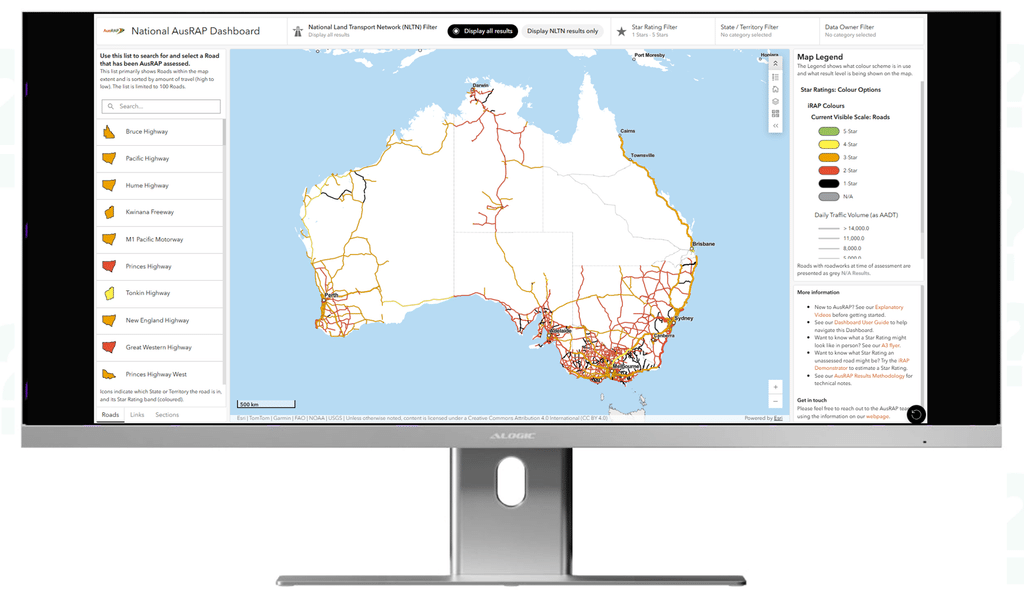
It was great to see this the AusRAP work recognised with a 2026 ACRS Excellence in Road Safety Award.
At Safe System Solutions, we’re involved in AusRAP assessments and advice, so I’m particularly excited about all these developments.
But risk assessment should be the beginning of the process, not the end. A colourful map showing high-risk roads is useful. A funded program that systematically transforms those roads is considerably more useful.
That’s why I was also pleased to see Brett Williams presenting examples of using Safe System Assessments to secure proactive Black Spot funding in South Australia.
Many of the team at Onkaparinga have been through the Safe System Assessment training, and it’s enormously satisfying to see people taking those skills back into their organisations and using them to get real projects funded.
The traditional reliance on crash history can leave dangerous locations untreated until enough people have been injured. Proactive assessment gives us an opportunity to intervene before that happens.
A much better way to run a road safety program.
6. Compact Roundabouts: Small Footprint, Big Potential
I’ve been a fan of compact roundabouts for some time, so it was good to see further research into their performance.
Dr Amolika Sinha introduced the work, with Chris Juriwic presenting Road Safety Victoria’s evaluation of rural compact roundabouts.
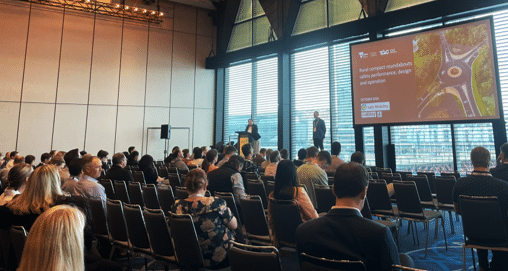
The findings were encouraging. Compact designs incorporating raised safety platforms demonstrated comparable or improved safety and speed outcomes relative to conventional roundabouts, while requiring less space and potentially costing substantially less.
The evaluation also reported acceptable heavy-vehicle performance, positive community feedback and sufficient capacity for lower-volume rural roads.
We developed the Victorian Department of Transport and Planning’s compact roundabout design guidelines at Safe System Solutions, so it’s pleasing to see the evidence base continuing. Here’s a link to that guidance:
7. Motorcycle Safety: Some Rather Concerning News
One presentation that caught my attention was from Christopher Hurren, examining changes in the protective performance of motorcycle clothing under the EN 17092 standard.
His research identified declining protective performance in some A and AA-certified motorcycle clothing, including reduced abrasion resistance in high-risk areas.
That’s a concerning finding.
Most riders would reasonably assume that buying certified protective clothing means they’re getting appropriate protection. If certification categories allow products with relatively poor abrasion resistance, particularly in areas likely to contact the road during a crash, that’s something we need to address.
It reinforces why independent assessment programs such as MotoCAP are important.
8. Road Safety Isn’t Someone Else’s Department
One recurring theme was the need to integrate road safety into everyday transport agency activities, rather than treating it as a separate discipline.
Dr Blair Turner presented work on better coordinating the Austroads Guides to Road Design, Traffic Management and Road Safety.
We still tend to divide planning, design, operations and safety into separate professional disciplines, each with its own guidance and processes.
The road user, of course, doesn’t care which department was responsible for a particular decision. They just experience the finished road.
Blair and I also had a good chat about how few practitioners seem to spend much time with Austroads Guide to Road Design Part 1.
If you’re only going to read one Austroads design guide, I’d make a strong case for Part 1. It sets out the philosophy and principles that should underpin the detailed design decisions.
Ishan Gangabada presented another practical example of integrated thinking, looking at embedding road safety improvements into motorway maintenance and renewal programs.
I’ve had several conversations with Ishan about this work, and I really like the approach.
We’re already spending money maintaining and renewing roads. Why not systematically use those opportunities to make them safer?
Elizabeth Waller also challenged us to learn from the rail sector, particularly around transparent safety and reliability metrics.
Liz is always a strong advocate for better road safety outcomes, and it’s worth asking why other transport sectors have developed more systematic approaches to measuring and managing operational risk.
9. Pedestrian Safety: Better Guidance and Better Measures
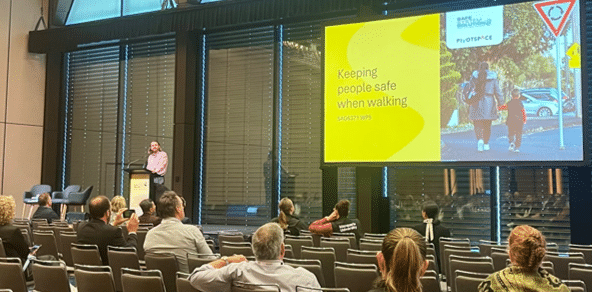
It was particularly good to see Max McCardel presenting the Austroads Keeping People Safe When Walking project.
This work has examined how pedestrian safety decisions are made across Australia and New Zealand, identified gaps in guidance and developed recommendations for improvement.
One challenge is that pedestrian safety guidance is scattered across numerous documents, standards and disciplines.
The result can be a process that focuses heavily on compliance with individual requirements without necessarily delivering a coherent Safe System outcome.
Dr Hafez Alavi also presented work developing pedestrian safety performance indicators and KPIs, including a proposed suite of 17 must-have safety performance indicators.
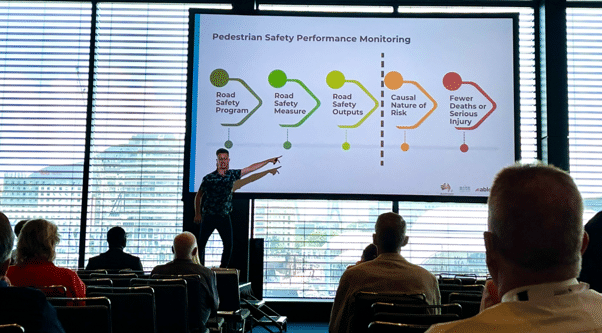
These are important because we need to measure more than crashes. We should be monitoring the conditions that create risk, such as vehicle speeds, crossing provision and infrastructure characteristics, rather than relying solely on the number of people killed or injured.
Dr Amir Sobhani added another contribution with research on pedestrian risk assessment using Empirical Bayes methods, identifying opportunities for proactive network-level analysis.
10. From Research to Real-World Results
Perhaps the most encouraging theme was seeing research and guidance being turned into practical action.
There’s no shortage of road safety research. We have decades of evidence about the treatments that work, the risks that matter and the design decisions that influence crash outcomes.
What we don’t always do particularly well is turn that knowledge into widespread changes across the road network.
That’s why I enjoyed presentations showing how practitioners are finding ways around the usual barriers of cost, complexity, limited data and funding constraints.
There was also some fascinating specialist work, including Johann Tay’s presentation on a forensic investigation into a serious signalised intersection crash where there was no CCTV or independent witness evidence.
Johann is part of our Safe System Forensics team, alongside David Beck, and it’s great to see this type of detailed investigation being shared with the broader industry.
Understanding how crashes actually happen, rather than relying on assumptions about what happened, can provide enormously valuable insights for prevention.
Across the conference, from compact roundabouts and Joey Crossings to proactive network planning and MOATS, there were plenty of examples of people trying to make good road safety practice easier to deliver.
We don’t necessarily need every solution to be new or technologically sophisticated. Sometimes we need to make an existing good idea cheaper, simpler, more repeatable or easier for someone in a small council to implement.
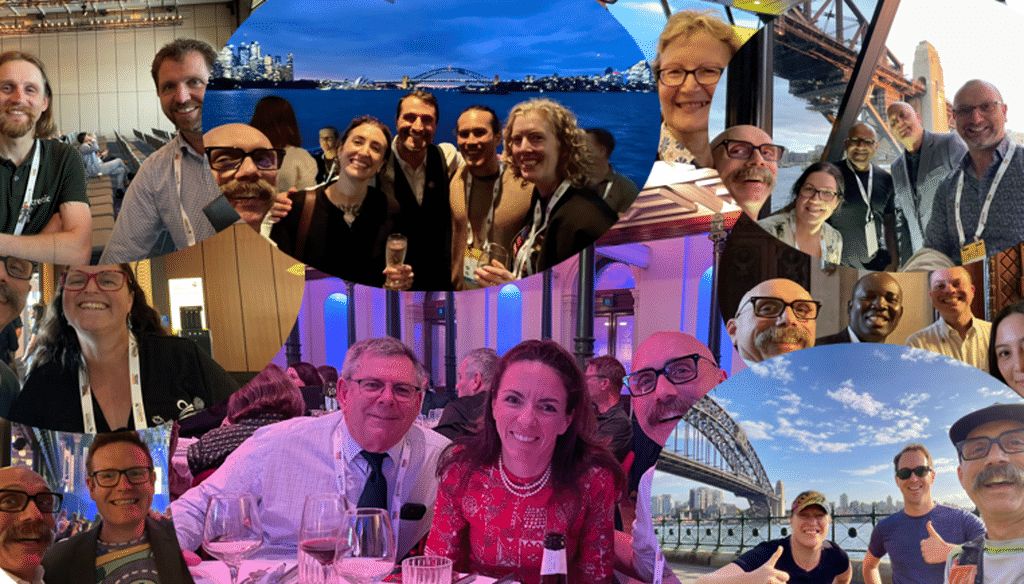
The Conversations Between the Presentations
Of course, the ten themes above are only part of what makes the Australasian Road Safety Conference worthwhile.
The presentations provide the research and technical content, but the conversations often help connect the dots.
Thanks
Thanks to the presenters, organisers and everyone who contributed to the conversations throughout the week.
And a special thanks to those who joined the morning runs. It’s always reassuring to discover there are other road safety people who think getting up early to run and discuss transport policy is a perfectly reasonable way to start the day.